Hi there! If you’re a wholesaler looking to source faucets, shower systems, or other taps for the Spanish market, you’ve probably heard the name “AENOR.” It can seem complicated, but I’m here to walk you through what it all means and, most importantly, what you need to look for in a manufacturing partner.
Think of this as your friendly guide to ensuring the products you stock are high-quality, safe, and—critically—100% compliant with Spanish regulations.
First, Who’s Who? AENOR vs. UNE
To get started, let’s clear up two names you’ll see a lot: AENOR and UNE. It’s easy to get them mixed up, but they have two very different jobs.
AENOR: The “Certifier”
AENOR (which stands for Asociación Española de Normalización y Certificación) is the leading company in Spain that checks if products meet the rules. Their whole mission is to create “trust” between companies and people.
Think of them as a commercial partner you hire to get your products certified, tested, and inspected. They are the ones who actually grant the quality marks you see on products. Their business is all about conformity assessment.
UNE: The “Rule-Writer”

UNE (Asociación Española de Normalización) is the only official national group in Spain that writes technical standards. They are the Spanish member of the big international standards bodies like ISO and CEN.
UNE’s job isn’t to certify anything. Their job is to create the technical rulebooks (you’ll see these standards listed as “UNE-EN 817,” for example).
Why This Matters to You (The 2017 Split)
For a long time, AENOR did both jobs: writing the rules and certifying products.
But on January 1, 2017, they split into two separate organizations. This actually makes your life easier:
- UNE is now the independent, non-profit group that only writes the standards.
- AENOR is the commercial company that tests and certifies products against those standards.
So, when you’re looking for a supplier, you’re not looking for “UNE certification.” You’re looking for products that are certified by AENOR against UNE standards.
The AENOR N Mark: The Symbol of Trust You’re Looking For
The most important thing you’ll see from AENOR is the N Mark. This is, by far, the most recognized quality symbol in all of Spain.
What the N Mark Guarantees
The N Mark is a “hallmark of quality”. Its purpose is simple: to guarantee that a product (like a faucet) does exactly what it’s supposed to do according to the technical standards. It’s AENOR’s way of telling the world they can “trust” (confianza) that product.
Getting this mark is voluntary—a manufacturer has to choose to go through the tough assessment process. That’s why it’s so valuable. It’s not a basic requirement; it’s a sign that the manufacturer is committed to quality.
Why This Mark is Your Best Sales Tool
The N Mark isn’t just a sticker; it’s a language of trust that everyone in the Spanish construction industry speaks. When your products have it, it makes your job as a wholesaler infinitely easier.
- For Public Administrations: Regulators see the N Mark and have “confidence” that the product is safe and legal.
- For Architects and Builders: This is your key market. The N Mark is the benchmark for construction and simplifies on-site product approval. Builders trust it because an independent third party has already verified the faucet, reducing the risk of inspector rejection and saving time and money.
- For Manufacturers: It helps them market over 100,000 certified products and even helps them sell internationally.
- For Your Customers (End-Users): It gives them an “objective guarantee” of quality and safety , which builds trust in the product and in you as the supplier.
The “Voluntary” Mark That’s Actually Essential
Okay, this is the most important part of the guide. While AENOR’s general marketing might call the N Mark “voluntary,” for faucets, it’s not really optional.
Here’s why.
The Law: Royal Decree 358/1985
There is a long-standing Spanish law, Royal Decree 358/1985, that makes it mandatory for all sanitary faucets (for kitchens, bathrooms, etc.) to meet specific technical standards.
The law was created to ensure “safety, health, and hygiene” and, very importantly, “the conservation of an increasingly scarce resource, as is water”. This law is still in force today and is what industry groups use to flag low-quality, non-compliant products.
The N Mark is the “Key” to This Law
So, how does a manufacturer prove they follow this mandatory law?
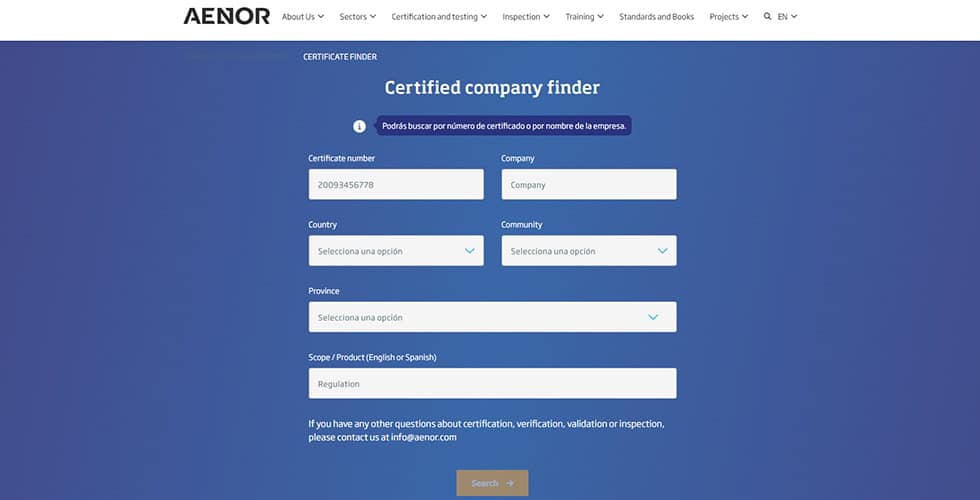
A separate regulatory provision clarifies it: the “certificate of conformity… AENOR CERTIFICATION N MARK FOR SANITARY TAPWARE PRODUCTS is recognized by the Spanish Ministry of Industry… as an alternative to Royal Decree 358/1985.”
This is the non-negotiable part. A manufacturer has two choices:
- Try to navigate a complex, direct “homologación” (approval) process with the government.
- Get the AENOR N Mark, which is the widely known, industry-standard, and Ministry-accepted way to prove compliance.
For any serious manufacturer, the N Mark is the only practical choice. It is the de facto mandatory, non-negotiable tool for proving legal compliance.
Why Builders (Your Customers) Must Have It: The CTE
The N Mark’s power is locked in by Spain’s Código Técnico de la Edificación (CTE), or Technical Building Code. This is the master rulebook for all new construction and renovations in Spain.
The AENOR N Mark is “a hallmark of quality acknowledged in regulations such as the Technical Building Code (CTE)”. It’s listed in the CTE’s General Register.
This has huge consequences for you. Because the N Mark is recognized by the CTE, architects will specify it in their blueprints, and builders will demand it from their suppliers (you!) to make sure the whole building is compliant. A faucet without an N Mark can be rejected on a building site by a municipal inspector.
A Deeper Look: What Is the N Mark Actually Testing?
When you find a manufacturer with an N-Marked faucet, it’s not just a single “pass/fail” test. It’s a whole certification scheme that covers everything.
The “Rulebook”: Specific Rules RP 03.01
If you look at an AENOR certificate for a faucet, you’ll see it’s “in accordance with Specific Rules RP 03.01”. This is the master document for the faucet certification program. It’s the “rulebook” that defines the entire process, including which standards to test, how often to audit the factory, and so on.
The Core Standards (The “What”)
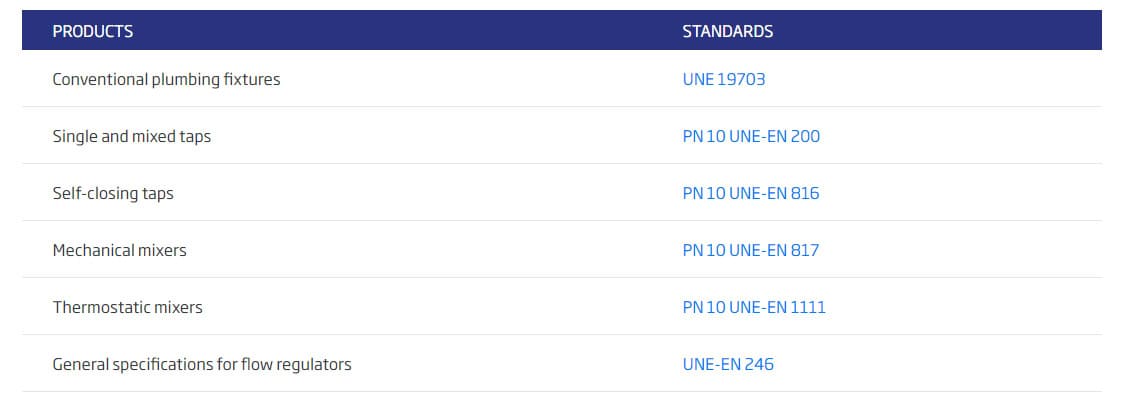
The RP 03.01 rulebook bundles together several key European (EN) standards, which Spain adopts as national (UNE) standards. The specific ones depend on the faucet type:
- UNE-EN 200: This is for your basic single taps and pillar taps. It covers dimensions, leaktightness, pressure, flow, strength, and endurance.
- UNE-EN 817: This is the big one for mechanical mixing valves (i.e., most of the single-lever mixers you sell). It’s a tough test for material quality, leaks, flow rate, mechanical durability (testing it over and over), and even noise. You’ll see this cited on many certificates.
- UNE-EN 1111: This applies to thermostatic mixing valves. It’s all about temperature performance and, most importantly, safety features like anti-scald protection.
The “Spanish Extra”: UNE 19703:2016
This is a key detail. You’ll notice that certificates often say the faucet complies with both UNE-EN 817 and UNE 19703:2016.
This is a specific Spanish standard that adds extra requirements on top of the European ones. For example, some manufacturers note their chrome finish is tested in a salt spray “according to UNE-19703”. This suggests Spain requires tougher durability tests, likely tied back to that 1985 law’s focus on longevity and water conservation.
(via.AENOR»)
Material Safety (No-Lead Guarantee)
The N Mark is also your guarantee of hygienic safety. AENOR certificates for faucets often declare compliance with the “Positive Lists 4MS (Common Approach), of materials in contact with drinking water”.
This 4MS initiative (from France, Germany, Netherlands, UK) is a harmonized list of approved materials.34 This is all driven by the EU’s strict Drinking Water Directive, which has a tiny limit for lead (10 $mu$g/L).
For you, this means that every “wetted part” of the faucet—the brass body, the flexible hoses, the O-rings—is made from an approved material. It’s a third-party guarantee that the faucet won’t leach lead, heavy metals, or other chemicals into the water.
The Finish: Testing the “Shine” with UNE-EN 248
Ever had a customer complain that a faucet’s chrome finish peeled or rusted? The N Mark prevents this. The RP 03.01 scheme requires testing against UNE-EN 248, the standard for Ni-Cr (nickel-chrome) coatings.
This isn’t just a quick look. The standard specifies :
- Corrosion Resistance: The faucet is blasted in a neutral salt spray (NSS) test.
- Adhesion: The coating is put through a thermal shock test (hot and cold) to make sure it doesn’t peel.
After the test, an inspector examines it under bright light. The rule is strict: there must be “no cracks, blisters nor loosening of the coating”.
How to “Read” the Mark: Performance Classifications
Here’s where it gets really useful for you as a wholesaler. The N Mark doesn’t just say “pass.” It gives you specific performance grades, allowing you to stock the right faucet for the right job.
Acoustic Performance (Is it Noisy?)
The EN 817 and EN 200 standards require testing the faucet’s noise level. Based on how quiet it is, it gets classified into a group. You’ll see this right on the AENOR certificate :
- Acoustic Group I: This is the quietest performance. These are premium faucets, and you can market them specifically for high-end homes, hospitals, and hotels where noise is a major concern.
- Acoustic Group II: This is the standard pass for general use.
- Unclassified: This means the tap is either louder than Group II or the manufacturer didn’t opt for the test.
Hydraulic Performance (Does it Save Water?)
This classification directly relates to Spain’s water-conservation law. The faucet is given a “Flow rate class” based on how much water comes out at a standard pressure (3 bar).
The classes are letters: Z, A, S, B, C, and D.
- Class Z or A: These are your low-flow, “eco-friendly” taps. Perfect for washbasins.
- Class S or B: Good medium-flow for kitchen sinks or showers.
- Class C or D: These are high-flow taps, designed specifically to fill a bathtub quickly.
This system lets you (and your customers) choose the exact right product instead of guessing.
It’s Not a One-Time Thing: How the Process Builds Trust
The AENOR N Mark is trusted because it’s not a one-time “pass.” When you’re vetting a supplier, understand that to keep their N Mark, they are in a continuous process with AENOR. The “Certification scheme” requires:
Initial Type Testing
Before anything, the manufacturer has to send their product to an ENAC-accredited lab to be put through the full range of tests (EN 817, EN 248, etc.).
Factory Audit
AENOR “has verified the quality system implemented for its manufacture”. This means inspectors go to the factory in person. They check that the manufacturer has a solid quality system (like ISO 9001 ) to ensure every faucet is made to the same standard as the one they tested.
Constant Check-ups (Ongoing Surveillance)
This is the key. The N Mark certificate is only valid for a set period (e.g., 5 years). To keep it, the manufacturer must agree to AENOR’s “periodic” surveillance. This includes:
- Annual Audits: AENOR inspectors come back every year to check the factory’s quality system.
- Periodic Sampling: AENOR takes new samples—either from the factory floor or even by buying them from a store—and re-tests them.
This continuous process guarantees that the manufacturer can’t cut corners after getting certified.
A Common Question: “But What About the CE Mark?”
This is a major point of confusion for anyone sourcing products in Europe. You see the CE mark everywhere. So, how does it relate to the N Mark?
Here’s the simple answer: For a standard mechanical faucet, the AENOR N Mark is the one that actually matters for quality and compliance.
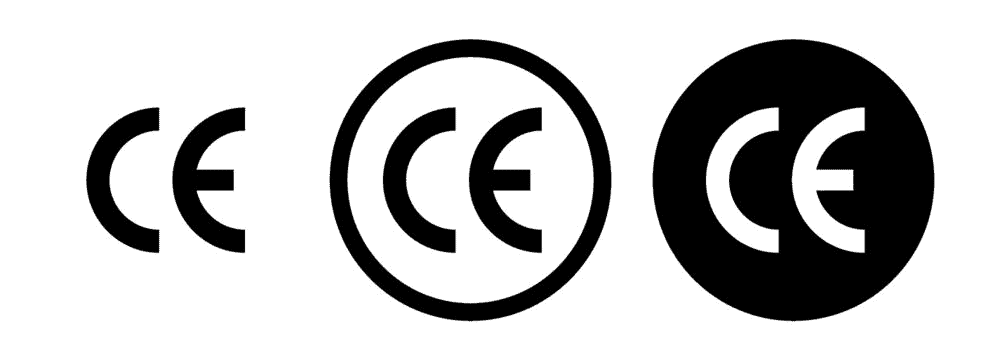
- CE Marking is a mandatory mark that says a product meets basic EU “health, safety, and environmental protection standards” . It is not a quality mark.
- A product only needs a CE mark if it’s covered by a harmonised European standard (hEN) under a regulation like the Construction Products Regulation (CPR).
- Here is the crucial part: The main standard for faucets, EN 200, is “not harmonised under the Construction Products Regulation” .
This means your typical mechanical faucet doesn’t even require a CE mark under the CPR. (An electronic or “smart” faucet would need a CE mark, but for its electrical safety (LVD) and electromagnetic compatibility (EMC), not for its water flow or durability ).
The N Mark is what “exceeds the basic requirements”. It’s the only mark that tests the faucet’s actual function, durability, water safety, and quality.
Just so you know, the AENOR N Mark is Spain’s “peer” to other major European quality marks, like the NF Mark in France and the DVGW Mark in Germany . They are all top-tier national marks and are not interchangeable.
The Future: The New AENOR N Sustainable (NS) Mark
Here’s a quick look ahead. AENOR recently launched the AENOR N Sustainable (NS) Mark. Sanitary taps are one of the products eligible for it.
What is it?
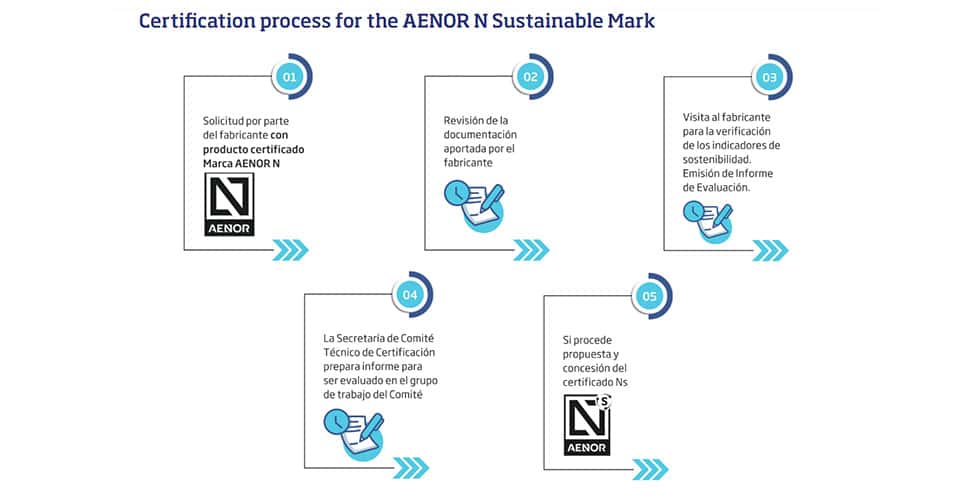
Think of it as a “Level 2” certification. It’s an add-on that is “based on the AENOR N Mark quality certification”.
This new mark expands the audit. It doesn’t just look at the product; it looks at the process behind it. It adds analysis of “environmental, social and governance aspects” (ESG) . AENOR checks at least 20 different indicators to see how sustainable the manufacturer’s entire operation is.
Why You Should Ask Suppliers About It
Here is the key sales pitch for you: The NS Mark is explicitly “in line with the requirements for accessing Next Generation European Funds”.
Billions of euros are being allocated for large-scale “green” construction and renovation projects across the EU. Public agencies spending this money will require products that meet these new sustainability criteria.
By sourcing from manufacturers who have the new NS Mark, you are positioning yourself to be a key supplier for these massive, high-value public projects.
Your Sourcing Checklist: What This All Means for You
Let’s boil this all down. As a wholesaler looking for a reliable, long-term manufacturing partner» for the Spanish market, here is your checklist.
- The N Mark is essential. Don’t let “voluntary” mislead you— for faucets, the AENOR N Mark is effectively mandatory. It’s the only recognized path to comply with Spain’s Royal Decree 358/1985 and the Technical Building Code (CTE). Sourcing without it brings major commercial and legal risks.
- Ask for the full scheme “RP 03.01.” You’re not looking for a faucet that passed a single test like EN 817. You need a manufacturer certified under the complete AENOR scheme, covering mechanical, coating, material safety, and Spain-specific requirements.
- Don’t rely on the CE mark. For mechanical faucets, the CE mark doesn’t represent real performance. A supplier saying “it’s CE marked” isn’t answering the right question. The N Mark is your true assurance of quality.
- Plan ahead: ask about the “NS” Mark. To stay competitive, check whether your supplier has—or is pursuing—the new AENOR N Sustainable (NS) Mark. This will be crucial for future large-scale, EU-funded green building projects.
Ultimately, by making the AENOR N Mark your primary requirement, you are protecting your business, building trust with your customers, and guaranteeing that the products you sell are safe, durable, and legally compliant in the Spanish market.